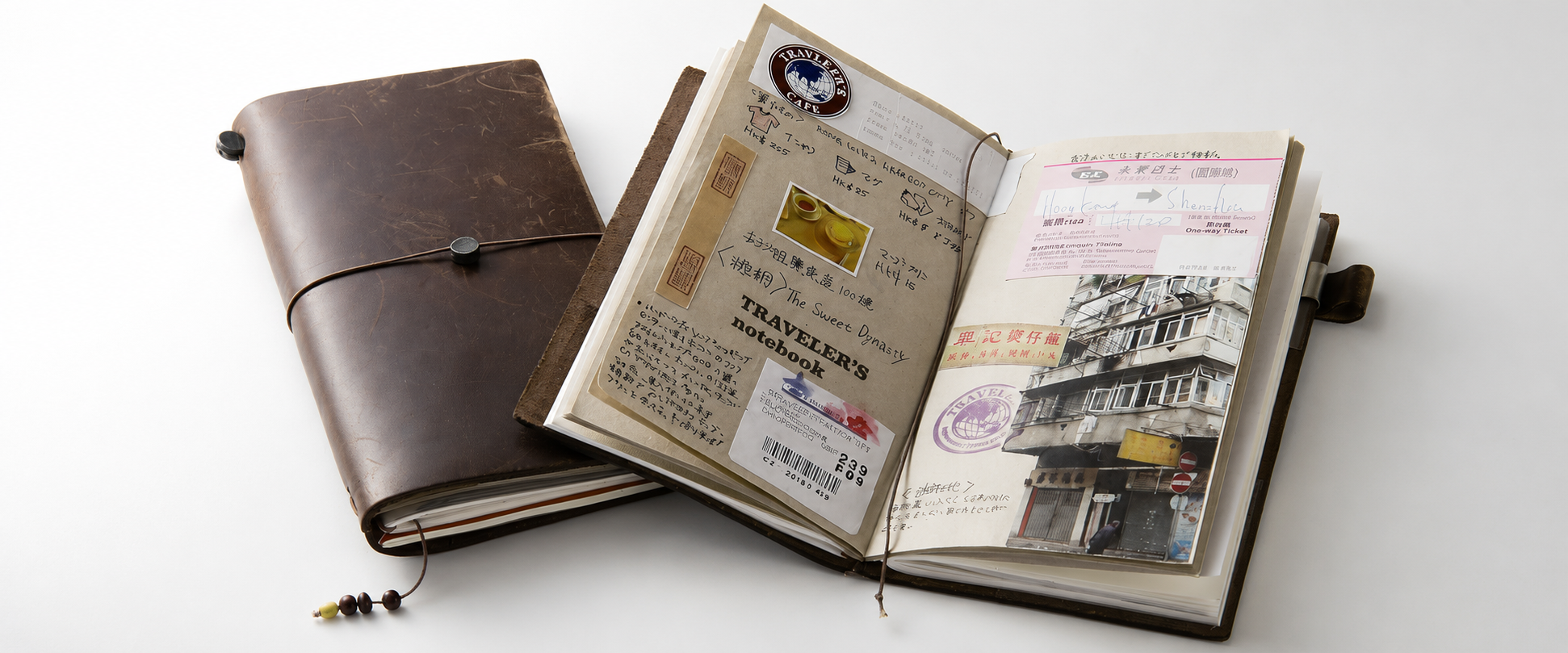
You’ve probably seen one without realizing it had a name.
A simple leather cover held shut with an elastic band. Maybe you spotted one in a TikTok “What’s in My Bag” video, an Instagram desk setup, or a YouTube video about travel journaling.
It didn’t look like a normal notebook. That’s because it isn’t.
This guide explains what a Traveler’s Notebook is, how it works, and why so many people never go back to ordinary notebooks after using one.
The Simple Answer…
At its core, a Traveler’s Notebook is surprisingly simple.
It’s a reusable cover, usually made from leather, that holds one or more slim paper notebooks with elastic bands. The elastic bands not only hold the notebooks inside of the cover but also wrap around the exterior to keep everything closed and secure. When an insert fills up, you replace the notebook insert and keep using the same cover.
That’s the entire idea.
It sounds almost too simple to explain why the system has developed such a devoted following.
Yet that simplicity is exactly what many people love. Instead of buying a brand-new notebook every time you finish one, you keep the part that grows more personal with age (the leather cover) and replace only the notebook inserts you’ve filled.
Think of it like a bookshelf.
You don’t replace the bookshelf every time you finish a book. You keep the shelf because it holds the stories that matter to you. A Traveler’s Notebook works much the same way.
The leather cover stays with you for years, while the notebooks inside change as your projects, travels, and routines evolve.
The system is built around four basic parts:
- The cover: A leather (sometimes fabric or “vegan” leather) cover that protects everything inside and gradually develops character through use.
- The inserts: Thin notebooks used for writing, sketching, planning, painting or keeping lists. Most people carry several at once for different purposes.
- The elastic bands: The cords that hold the inserts in place while making it easy to add, remove, or rearrange them.
- Optional accessories: Folder inserts, zipper pouches, card holders, pen loops, and connecting bands that let you customize the notebook without permanently changing it.


Because the system is modular, no two setups look exactly alike.
One person might carry a calendar, a sketchbook, and a dotted-graph notebook for work. Another might combine a sketchbook with a travel diary and a folder for tickets and postcards. The cover stays the same, but what lives inside reflects the way its owner thinks and works.
That’s one reason people often describe a Traveler’s Notebook as something they build over time rather than simply buy.
Why Do Some People Call It a Midori Notebook?
If you’ve spent more than a few minutes researching Traveler’s Notebooks, you’ve probably run into another name:
Midori.
That can be confusing because you’ll also see people mention Traveler’s Company, and sometimes it sounds as though they’re talking about two different products.
They’re not.
The notebook system was originally introduced in Japan by Midori, a stationery company known for simple, well-made paper products. In 2015, the Traveler’s Notebook line became its own spin-off brand under the name Traveler’s Company.
That’s why longtime users still refer to them as Midori notebooks, while newer users are more likely to say Traveler’s Notebook or Traveler’s Company Notebook. Both names usually describe the same exact notebook system.
Today, you’ll also find dozens and dozens of companies making “Travelers Notebooks” based on the same concept.
However, the original Traveler’s Company notebooks remain the reference point that most people compare everything else against. They are the originators.
Why Do People Love Traveler’s Notebooks?
On paper, a Traveler’s Notebook doesn’t seem all that remarkable.
It’s a leather cover, a few thin notebooks, and some elastic bands.
There are cheaper notebooks. There are notebooks with more features. There are planners with more organization and journals with thicker paper.
Yet people who start using Traveler’s Notebooks often stick with them for years.
The reason has very little to do with the notebook itself. It has everything to do with the way the system fits into everyday life.
You keep the part that matters.
With most notebooks, everything gets replaced when you fill the last page.
A Traveler’s Notebook works differently.
The paper comes and goes, but the cover stays.
Over time it picks up scratches, softens at the edges, and darkens where your hands hold it most. Instead of looking worn out, it begins to reflect the places it’s been and the work you’ve done with it.
For many owners, that leather cover becomes more like a favorite backpack or a well-used wallet than another piece of stationery.
It adapts instead of forcing you into one system.
Most notebooks ask you to decide what they’ll be before you ever write the first page.
Journal.
Planner.
Sketchbook.
Notebook.
A Traveler’s Notebook doesn’t make that decision for you.
You can carry several inserts at once, swap them whenever your needs change, or dedicate each one to a different part of your life. Work notes might sit beside a travel journal, a reading log, or a notebook for ideas.
The system changes with you instead of asking you to start over.
It makes imperfections feel normal.
One theme appears again and again when longtime users talk about Traveler’s Notebooks.
They stop worrying about ruining them.
A page doesn’t have to be perfect because the notebook isn’t trying to become a polished keepsake. It’s a place for half-finished thoughts, rough sketches, grocery lists, boarding passes, and ideas that may never go anywhere.
Ironically, many people find themselves journaling more often because the notebook feels less precious than they expected.
Choosing the Right Traveler’s Notebook Size
One of the first things you’ll notice while shopping is that Traveler’s Notebooks come in several sizes.
The good news is that you don’t need to memorize measurements to choose the right one.
For most people, it comes down to two options: Passport and Regular.
Passport Size

The Passport size is designed to be as portable as possible.
It slips easily into a jacket pocket, a small crossbody bag, or the side pocket of a backpack, making it a favorite for travelers and people who like carrying a notebook everywhere they go.
Most Passport covers measure about 105 × 135 mm (4.1 × 5.3 in) when closed and approximately 210 × 135 mm (8.3 × 5.3 in) when opened. They’re designed to hold Passport-size notebook inserts measuring roughly 90 × 125 mm (3.5 × 4.9 in). Very similar in size to an actual Passport book, hence the name.
The tradeoff is writing space.
Long journal entries can feel a little cramped, but for quick notes, lists, travel memories, and everyday carry, many people find it’s all they need.
Regular Size

The Regular size is what most people picture when they think of a Traveler’s Notebook.
It’s large enough for comfortable journaling, planning, sketching, and longer writing sessions while still being compact enough to carry in a backpack or tote bag.
Most Regular covers measure about 120 × 220 mm (4.7 × 8.7 in) when closed and approximately 240 × 220 mm (9.4 × 8.7 in) when opened. They’re designed to hold Standard-size notebook inserts measuring roughly 110 × 210 mm (4.3 × 8.3 in).
If you’re buying your first Traveler’s Notebook and aren’t sure where to start, this is usually the safest choice.
What about A5, B6, and other sizes?
One reason Traveler’s Notebooks have become so popular is that many other major players and small independent makers have adapted the concept to other notebook sizes.
You’ll find A5, A6, B6, B6 Slim, Personal, Pocket, and countless other custom formats.
These can be excellent options if you already have a favorite paper size or planner system.
That said, if you’re looking at Traveler’s Company notebooks specifically, Passport and Regular remain the two official sizes.
Which size should you choose?
There’s no universally “better” size.
The best choice depends on how you expect to use it.
| If you want to… | Consider… |
| Carry it every day | Passport |
| Journal regularly | Regular |
| Travel as light as possible | Passport |
| Sketch or write longer entries | Regular |
| Buy your first Traveler’s Notebook | Regular |
Is a Traveler’s Notebook Right for You?
A Traveler’s Notebook isn’t the perfect notebook for everyone.
That’s part of its appeal.
It’s designed around a very specific idea: your notebook should adapt to the way you live instead of forcing you into a fixed format.
For some people, that’s exactly what they’ve been looking for.
For others, a traditional notebook is simply a better fit.
You’ll probably enjoy one if…
You like keeping different parts of your life separate.
Instead of cramming everything into one notebook, you can dedicate an insert to work, another to journaling, another to travel, and another to ideas.
Everything stays together without becoming disorganized.
You enjoy using things for a long time.
Some people replace their notebook every few months and never think about it again.
Others keep the same favorite backpack, wallet, or fountain pen for years because those objects become more personal with use.
Traveler’s Notebooks tend to appeal to the second group.
The leather isn’t supposed to stay perfect. It’s supposed to become yours.
You appreciate customization.
No two Traveler’s Notebooks have to look alike.
Some people carry two inserts.
Others carry five.
Some keep everything minimal.
Others fill theirs with folders, stickers, clips, and travel ephemera collected over years.
The notebook becomes a reflection of how you think rather than something designed around someone else’s workflow.

Just as importantly, there are a few situations where a Traveler’s Notebook may not be the best option.
You want one large notebook.
If you regularly fill hundreds of pages before starting a new notebook, swapping smaller inserts may feel unnecessary.
A bound journal or hardcover notebook will probably suit you better.
You prefer perfectly flat pages.
Although many inserts open comfortably after some use, a Traveler’s Notebook isn’t as rigid or stable as writing in a hardcover notebook on a desk.
If you frequently write long sessions without a table, that’s worth considering.
You don’t enjoy maintaining leather.
Leather changes.
It scratches.
It softens.
It darkens.
Many owners love those signs of use. Others simply want something that looks exactly the same every day.
Neither preference is wrong. They’re just different expectations.
You want the cheapest notebook possible.
Traveler’s Notebooks aren’t expensive because of the paper. The paper inserts are relatively affordable. The investment is in the reusable cover that’s meant to stay with you for years.
If your goal is simply having somewhere to write, there are many excellent notebooks that cost less.
One interesting pattern appears again and again when you read reviews or talk to longtime users.
Very few people become attached to Traveler’s Notebooks because of a single feature.
It’s usually the combination.
The simplicity.
The flexibility.
The feeling of carrying one notebook that’s gradually shaped by years of everyday use.
That’s difficult to explain until you’ve lived with one for a while.
Which may be why so many owners describe them less as stationery and more as something they carry every day.

Frequently Asked Questions
Are Traveler’s Notebooks worth it?
For many people, yes—but not because they’re filled with premium features.
What you’re really paying for is a notebook you’ll continue using long after the first insert is full. Instead of replacing the entire notebook every few months, you keep the cover and simply replace the contents inside.
If that idea appeals to you, the value becomes easier to understand.
If you prefer using a notebook until it’s full and then starting fresh, a traditional notebook will probably feel like the simpler choice.
Why are Traveler’s Notebooks so expensive?
Traveler’s Notebooks are designed to last for years, not months. A quality leather cover gradually softens, develops character, and becomes more personal the longer you use it. The inserts are relatively inexpensive and are meant to be replaced whenever you fill one.
It’s a different way of thinking about notebooks: invest once in the cover, then keep replacing the paper.
Even if the leather is die-cut at the factory, there is no machine that can install the elastic system into each cover. That’s done by hand.
It’s not fair to compare that process to a standard notebook which is entirely mass produced with advanced machinery.
A quality leather cover from a well-known brand typically costs between $40 and $80, while premium handmade versions often range from $100 to $200 or more, depending on the leather, brand, and craftsmanship.
The good news is that the paper is inexpensive. Most notebook inserts cost between $3 and $15, so once you own the cover, the ongoing cost of using the system is relatively low.
That’s also why longtime users often describe a Traveler’s Notebook as an investment in the cover rather than the paper.
Can you use any notebook as an insert?
Many companies make inserts that fit the standard Traveler’s Notebook sizes, so you aren’t limited to a single brand. You can also make your own inserts if you enjoy bookbinding or want a specific paper.
The important thing is choosing inserts that match the dimensions of your cover.
Do Traveler’s Notebooks lay flat?
Generally, yes—but not in exactly the same way as a hardcover notebook.
Most inserts become easier to open after they’ve been used for a while, especially when writing near the middle of the notebook. Because the inserts are held in place with elastic rather than glued into a rigid spine, the writing experience feels slightly different from a traditional bound notebook.
For most people, it’s something they stop noticing after a short time.
If this is a dealbreaker you can always remove the insert you are currently working on while writing and put it back when you’re done. That’s the beauty of the elastic system.
What’s the difference between a Traveler’s Notebook and a travel journal?
The terms are often used interchangeably, but they aren’t quite the same thing.
A travel journal describes how you use a notebook.
A Traveler’s Notebook describes the notebook system itself.
Many people use a Traveler’s Notebook as a travel journal, but it can just as easily become a daily planner, work notebook, sketchbook, reading journal, or combination of all four.
Can you make your own Traveler’s Notebook?
Absolutely.In fact, that’s one of the reasons this style of notebook has become so popular with leatherworkers and DIY enthusiasts.
The design is extremely simple, making it an approachable project even if you’ve never made a leather notebook before.
If you’d like to build your own, we’ve put together a complete tutorial that walks through the process step by step, along with a free printable pattern to help you get started.
→ How to Make a Leather Journal Cover
→ Free Traveler’s Notebook PDF Pattern Set
Which size should I buy first?
If you’re unsure, the Regular size is the standard place to start.
It offers enough writing space for journaling, planning, and everyday notes while remaining portable enough to carry in a bag.
The Passport size is better if you want something that fits in a jacket pocket or prefer traveling light.
Neither is objectively better—they simply suit different habits.
If you wish to explore options outside of Travelers Company product line up, you can find travelers notebooks in almost any size imaginable.
Where to Go From Here
By now, you should have a good idea of whether a Traveler’s Notebook fits the way you like to work.
If the idea of carrying one notebook that changes with you over time appeals to you, there are a few ways to continue:
- Buy your first Traveler’s Notebook if you’re ready to experience the system for yourself.
- Learn how to make your own if you’d rather build one from scratch.
- Download a free printable pattern and see how the design comes together before investing in materials.
The notebook itself is remarkably simple.
The interesting part is what people choose to do with it.
And that’s why, more than twenty years after its introduction, the Traveler’s Notebook continues to attract people who enjoy slowing down, writing by hand, and carrying something that becomes more personal with every page they fill.